


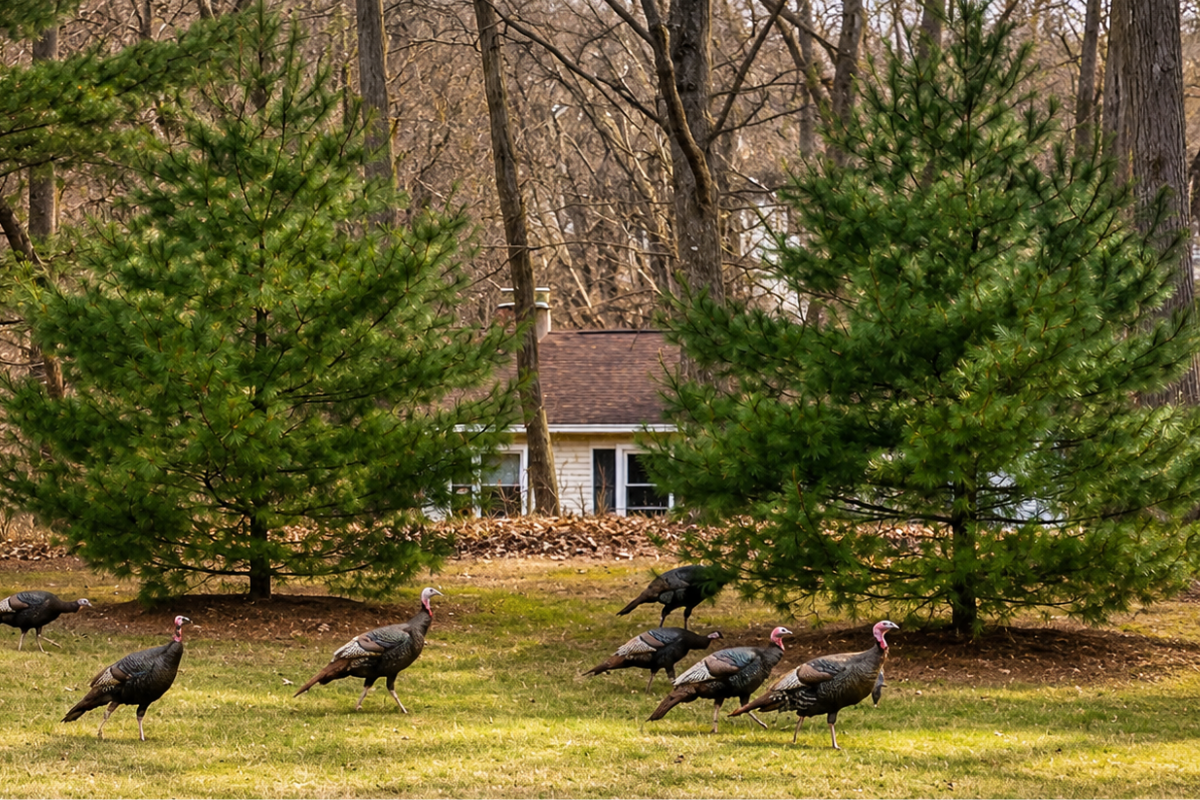
Every spring, a new family of turkeys would wander through the lawns and woods near my home. Wild turkeys (Meleagris gallopavo) are native to North America, with ancestors dating back millions of years.
Turkeys are a familiar symbol of Thanksgiving, but their history goes far beyond the holiday. When European settlers first arrived in Connecticut, wild turkeys were common. However, forest clearing for farmland and heavy hunting wiped them out in the state by the early 1800s.
Between 1975 and 1992, 356 wild turkeys were released at 18 sites across Connecticut. Thanks to these restoration efforts and the return of hardwood forests, wild turkeys can now be found in all 169 Connecticut towns.
Where Wild Turkeys Live
Wild turkeys are woodland birds that thrive along the edges of hardwood forests, particularly oak-hickory and pine-oak woodlands, and in areas with thick vegetation.
They spend much of their day foraging, scratching through fallen leaves in search of seeds, grains, berries, buds, grasses, acorns, corn, and insects. Young turkeys, called poults, feed primarily on insects.
Spring Courtship and Nesting
In spring, male wild turkeys, known as toms, gobble to attract females. During courtship, they puff up their feathers, fan their tails, swell their wattles, and lower their wings. As they strut, they shake their wing feathers and make low humming sounds.
Wild turkeys are polygamous. Toms may mate with several hens, and hens may mate with more than one tom. Males establish a pecking order, with the dominant male often mating with most of the nearby hens.
Turkeys nest on the ground, usually at the base of a tree, beneath a shrub, or in tall grass. Their nests are simple, shallow depressions lined with grass and leaves.
A hen typically lays 10 to 15 eggs, white or pale buff in color with reddish-brown spots. The eggs hatch after approximately 25 to 31 days.
Once the poults hatch, they remain with their mother through summer, fall, and winter. By late summer, hens and their young begin joining together to form larger flocks.
While some Connecticut flocks may contain as many as 100 birds, most consist of 10 to 20. Adult toms occasionally join these flocks, although they typically form their own groups or travel alone.
Where Do Turkeys Sleep?
Although wild turkeys spend most of their day on the ground, they usually sleep in trees.
At dusk, they fly up one at a time to roost in the upper branches of large hardwood trees, such as oaks and maples, or in tall evergreens, often 30 to 50 feet high.
They may hop from lower to higher branches, seeking protection from predators such as coyotes, foxes, and bobcats. During cold or stormy weather, turkeys favor sheltered evergreens or other locations that offer protection from wind and snow.
At daybreak, turkeys call to one another to locate members of their flock. Once they sense it is safe, they glide down from their roosts, one by one, and gather again.
Do Wild Turkeys Migrate?
Wild turkeys do not migrate, but they move around in search of food and shelter as the seasons change. In fall, they settle into winter roosting areas, remaining nearby through winter and early spring. During spring and summer, they spread out over several miles, making their roosting locations less predictable.
Predators and Survival
Turkeys have poor night vision, and their large size makes them vulnerable to predators, including coyotes, bobcats, foxes, and owls. Hens are particularly vulnerable during the approximately 28-day incubation period and for the first two to three weeks after their poults hatch. During this time, both mother and young sleep on the ground.
Once poults develop the ability to fly and roost in trees, their chances of survival improve significantly. Wild turkeys in Connecticut typically live three to five years in the wild. Hens average three to five years, while toms may live around four years.
Some wild turkeys survive more than 10 years, with rare records reaching 15 years. However, predators, harsh weather, disease, hunting, and high mortality among eggs and young poults often shorten their lives.
How Fast Can a Wild Turkey Run?
Wild turkeys are surprisingly fast! In short bursts, they can run up to 25 miles per hour. For comparison, a recreational runner might reach speeds of 10 to 15 miles per hour. Perhaps that’s why so many fall road races are called “Turkey Trots.” And running isn’t their only talent. Despite their size, wild turkeys are powerful flyers over short distances, reaching speeds of up to 55 miles per hour.
The next time you spot a flock wandering through Bethel’s woods or crossing a neighborhood lawn, take a moment to appreciate these remarkable birds and their successful return to Connecticut’s landscape.




060324.png)


