


Every five years, I spend a few weeks cutting back invasive plants around Mike’s Pond. This small nature preserve is owned by the Bethel Land Trust.
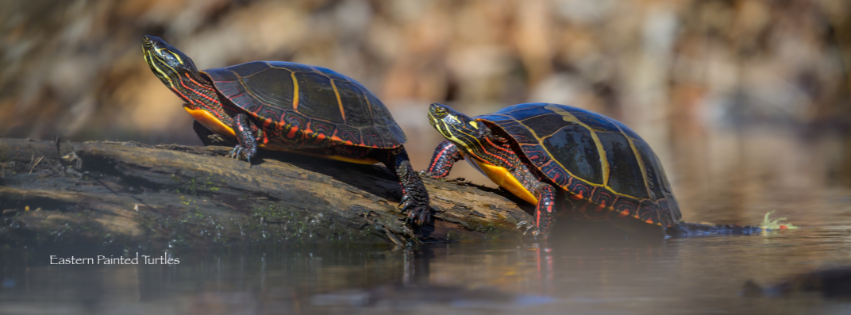
One of the things I enjoy most about caring for the preserve is watching Eastern Painted Turtles bask in the sun on fallen branches and rocks by the pond.
Painted Turtles are small freshwater turtles found all over North America. There are four subspecies, and the one east of the Appalachians is called the Eastern Painted Turtle (C. picta picta).
Eastern Painted Turtles are the most common turtle species in Connecticut. They live in slow-moving waters like ponds, lakes, bogs, and wetlands. You’ll often see them lined up on logs or rocks, soaking up the sun to warm themselves. At Mike’s Pond, they like places with aquatic plants, soft bottoms, and good spots for basking.
Let’s take a closer look at my friend from Mike’s Pond:
The top shell, or carapace:
- Smooth, low, and oval-shaped
- Usually dark olive, black, or dark brown
- The edges of the shell have thin red, orange, or yellow markings
The carapace is made up of individual plates called scutes. They are made of keratin, the same material as your fingernails. The grooves between the scutes are called sutures or seams.
The colorful yellow, orange, and red lines that run across the shell and edges of the shell are referred to as stripes, streaks, or radiant markings.
The bottom shell, or plastron:
- Bright yellow to cream-colored
- Usually plain, with little or no dark patterning
A Painted Turtle’s shell isn’t just an outer covering; it’s actually part of the skeleton and includes the backbone. Each shell has about 60 bones.
They’re also beautiful, with red and yellow stripes on their necks, legs, and tails that make them stand out.
Lifespan: 20–40 years in the wild
Painted Turtles eat both plants and animals, including aquatic insects, crustaceans, small fish, snails, and different kinds of vegetation. Young turtles eat more animal food, but as they grow, they eat more plants, such as duckweed, which is common in Mike’s Pond.
Eastern Painted Turtles usually nest from late May to early July. After mating, females leave the water, often in June, to find a sunny spot with soft, sandy soil. They use their back legs to dig a shallow nest, lay their eggs, cover them up, and then return to the water. The eggs and hatchlings are left on their own.
Females generally lay one or two clutches per season, with about two to three weeks between nests. A typical clutch contains five or six eggs. The eggs are white to off-white and oval to slightly elongated.
The eggs incubate for 60 to 90 days and usually hatch in late summer or early fall. If hatchlings come out too late, they may stay in the nest through the winter and survive temperatures as low as -10°C, then emerge the next spring.
Both males and females have multiple mates, so one clutch can have more than one father. Not all adult females lay eggs every year; about 30 to 50 percent skip breeding in a given season.
Eastern Painted Turtles often return to the same nesting spots year after year. Females sometimes dig several false nests to help protect their eggs from predators. The temperature of the nest determines the sex of the hatchlings, with warmer nests producing more females.
Turtle eggs and hatchlings are easy targets for raccoons, skunks, opossums, foxes, coyotes, and birds. Those that make it to adulthood are protected by their hard shells.
When temperatures drop in November, Painted Turtles start to hibernate. They usually settle at the bottom of a lake, pond, or marsh and cover themselves with mud. In the cold, they can survive for a long time in water with very little oxygen. They switch to anaerobic respiration, which produces lactic acid.
Too much lactic acid can upset their blood’s pH and slow down enzymes, but turtles handle this by releasing calcium and magnesium carbonates to neutralize the acid. They also slow their metabolism by more than 95 percent during hibernation.
And did you know?
Painted Turtles have tongues that don’t move freely, so they need to be submerged in water to properly swallow their food!




060324.png)
.png)

%20(500%20x%20500%20px).png)
